
Chemical Heat Treatment Strengthening of Springs: Gas, Soft and Ion Nitriding
 Chemical heat treatment is one of the most effective ways to strengthen the surface of steel springs without sacrificing the toughness of their core. In spring manufacturing, where fatigue life, load stability and dimensional precision decide whether a part survives millions of duty cycles, nitriding-based surface treatments have become a core technology. This guide explains how chemical heat treatment works, the three main processes — gas nitriding, soft nitriding (nitrocarburizing) and ion nitriding — and why these techniques matter when you are specifying custom springs for demanding applications.
What Is Chemical Heat Treatment of Steel?
Chemical heat treatment is a heat-treatment process in which a component is placed in a special medium, heated and held at temperature so that one or more elements from the medium penetrate the surface layer of the part. This changes both the composition and the microstructure of the surface, and thereby alters its service properties. For springs, the process is used to modify the surface so that it can withstand wear, corrosion and cyclic fatigue better than the un-treated material.
The process always involves three basic stages:
- Decomposition — the chemical agent decomposes under heating (and with the help of catalysts) to produce active atoms.
- Absorption — the active atoms dissolve into the iron lattice to form a solid solution, or combine with an element in the steel to form a compound, i.e., the atoms are absorbed by the workpiece surface.
- Diffusion — the active atoms diffuse progressively from the surface inward, forming a diffusion layer of controlled depth.
The commonly used chemical heat-treatment processes include carburizing, nitriding, nitrocarburizing (soft nitriding), carbonitriding and the penetration of metallic elements. On springs, the processes actually used are nitriding and nitrocarburizing. The remainder of this article focuses on these.
Gas Nitriding: The Foundation of Spring Surface Hardening
Gas nitriding is the oldest and most widely documented nitriding route. The technique was published by the German researcher A. Fry in 1923. In gas nitriding, the workpiece is placed in a furnace and ammonia gas (NH₃) is introduced directly into the chamber. Typical parameters are a furnace temperature of 500–550 °C held for 20–100 hours, during which the ammonia dissociates into atomic nitrogen (N) and hydrogen (H) so that nitrogen can be absorbed into the steel surface.
The primary purpose of gas nitriding is to create a hard, wear-resistant and corrosion-resistant compound layer on the surface.
The Reaction Mechanism
Gas nitriding relies on the thermal decomposition of ammonia:
2NH₃ ⇌ 3H₂ + 2N
The active nitrogen atoms generated by decomposition meet the iron at the surface and react to enter the part. Nitrogen either dissolves into ferrite or austenite, or reacts with iron to form Fe₄N (the γ phase) and Fe₂₋₃N (the ε phase):
Fe + N ⇌ Fe(N) ; 4Fe + N ⇌ Fe₄N ; (2–3)Fe + N ⇌ Fe₂₋₃N
During nitriding, the steel part itself acts as a catalyst for the ammonia-decomposition reaction, so that the ammonia in contact with the surface efficiently supplies active nitrogen atoms. As a result, the lower the decomposition rate of the ammonia, the stronger the capability of the medium to supply nitrogen that can be absorbed into the part. However, the decomposition rate must not be too low — otherwise the surface of alloy-steel parts can develop a brittle white layer (white bright layer).
Controlling Ammonia Decomposition Rate
The decomposition rate of ammonia changes with the ammonia flow rate and the temperature. The larger the flow rate, the lower the decomposition rate; the smaller the flow rate, the higher the decomposition rate. Likewise, the higher the temperature, the higher the decomposition rate, and the lower the temperature, the lower the decomposition rate. In practice, the flow and temperature are balanced to maintain the decomposition rate in the optimum range for the grade being processed.
Nitrided Layer Structure and Properties
After nitriding, general alloy structural steels and tool steels show a surface compound layer (the white bright layer) with a diffusion layer just beneath it. The white bright layer is typically 10–80 μm thick, extremely hard (reaching 1000–1200 HV) but also extremely brittle.
The surface performance of the nitrided layer is distinctive:spring
- Its hardness does not drop even when maintained at around 600 °C, giving excellent wear resistance and hot hardness.
- Nitriding leaves a compressive stress layer on the surface, which markedly improves the fatigue resistance of the part.
- The nitriding surface phase is corrosion-resistant and remains bright for long periods in water, steam and alkalis.
Because gas nitriding via ammonia decomposition has a relatively low efficiency, it is generally applied to steels selected specifically for nitriding. Typical grades are those alloyed with Al, Cr and Mo — the classic nitriding steel 38CrMoAl, together with 35CrMo, 42CrMo and 40CrNiMo. Japanese JIS grades such as SACM1, SACM645 and SKD61, plus several martensitic and austenitic stainless steels (SAE 400 and SAE 300 series) and precipitation-hardening stainless steels (17-4PH and 17-7PH), also respond well to nitriding. To obtain good combined mechanical properties, the part is usually pre-treated by hardening and tempering (quenching and tempering) before nitriding.
Depending on the part requirements, one-, two- and three-stage nitriding schedules have been developed for structural steels, tool steels and stainless steels. Process windows vary: for example 38CrMoAl may run at 510±10 °C for about 80 hours with a decomposition rate of 15–35% to give a case depth of roughly 0.40–0.70 mm and a surface hardness above 1000 HV; Cr12 and Cr12Mo grades are nitrided around 480–530 °C for 12–16 hours to reach 1000–1100 HV; while stainless steels such as 1Cr13 and 1Cr18Ni9Ti are processed at higher temperatures for shorter times to reach surface hardnesses of 700–1300 HV depending on schedule. Regardless of the route, spring components are selected for the schedule that delivers the required case depth and hardness while preserving the load-carrying core.
Limitations of Gas Nitriding
Ammonia-gas nitriding does have well-known drawbacks: it tends to produce a rough surface, the nitrided layer is hard and rather brittle and difficult to grind, and processing times are long, which raises production cost. These limitations are precisely why soft nitriding and ion nitriding have gained ground in modern spring manufacture.
Soft Nitriding (Nitrocarburizing): Lower Temperature, Less Brittleness
Soft nitriding is, in essence, a low-temperature nitrocarburizing process in which nitriding dominates while a small amount of carbon also diffuses into the surface. Compared with ordinary gas nitriding, the resulting layer is lower in hardness but considerably less brittle — hence the name “soft nitriding.”
Soft nitriding is divided into gas, liquid and solid methods, and gas soft nitriding is by far the most widely used in production. In gas soft nitriding, the workpiece is treated in an atmosphere containing active nitrogen and carbon atoms. The common media are urea, formamide, ammonia and triethanolamine, which decompose at the soft-nitriding temperature to provide the active nitrogen and carbon atoms. These are absorbed by the surface and diffuse inward to form a nitrogen-dominated nitrocarburized layer.
Process Parameters
For carbon steel, nitrocarburizing is divided into two temperature regimes by the nature of the treatment:
- Ferritic nitrocarburizing at 520–590 °C, and
- Austenitic nitrocarburizing at 600–720 °C.
Treatment time is generally 2–6 hours. The former yields a white bright layer of iron-nitrogen compounds; the latter, after fast cooling, gives an additional 5–12 μm nitrogen-bearing austenite + martensite layer beneath the iron-nitrogen compound layer. Chinese heat-treatment engineers have also developed variants in which boron, oxygen, sulfur or rare-earth elements are added, alone or in combination, alongside nitrogen to enhance the white bright layer.
In production the soft-nitriding temperature is commonly 560–570 °C, because the nitrided layer reaches its highest hardness in this range. Nitriding time is typically 2–3 hours, since beyond about 2.5 hours the case depth increases only very slowly with time.
Soft Nitriding Layer Structure
After soft nitriding, the outermost layer is a white bright layer of several to tens of microns (generally 10–20 μm, sometimes above 20 μm where specified), composed of the ε phase, the γ phase and nitrogen-bearing cementite Fe₃(C, N). The sub-layer is a diffusion layer consisting mainly of the γ′ and ε phases.
Advantages of Soft Nitriding
- Low treatment temperature and short time, so workpiece deformation is small.
- Not restricted by steel type — carbon steels, low-alloy steels, tool steels, stainless steels, cast irons and iron-based powder-metallurgy materials can all be soft-nitrided.
- Markedly improves fatigue strength, wear resistance and corrosion resistance, and, under dry friction, provides resistance to scuffing and galling.
- Because the soft-nitriding layer contains no brittle ξ phase, the layer is hard yet retains a degree of toughness and does not easily spall off.
For these reasons, soft nitriding is widely used for moulds, gauges, tools (including high-speed-steel cutters), crankshafts, gears, cylinder liners and mechanical structural parts. For springs, its low-temperature, low-deformation character makes it especially attractive.
Ion Nitriding (Plasma Nitriding): Clean, Fast and Precise
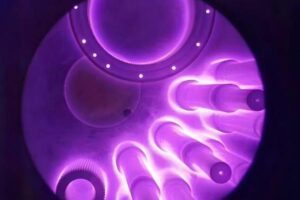
Ion nitriding was invented by the German B. Berghaus in 1932. The part is placed in a nitrogen-bearing atmosphere at 0.1–10 Torr; the furnace body serves as the anode and the workpiece as the cathode, and a DC voltage of several hundred volts is applied between them. The resulting glow discharge produces a soft light, similar to a neon lamp, covering the workpiece surface. Ionized gas species are accelerated by the electric field and strike the surface, heating it while supplying nitrogen through sputtering and ionization effects.
Unlike conventional ammonia decomposition or cyanide-based methods, ion nitriding is a fundamentally different approach and is now widely applied in automobiles, machinery, precision instruments and moulds.
Advantages of Ion Nitriding
- Because it uses ionized nitrogen-bearing gas (N₂ + H₂) rather than a chemical reaction, the working environment is clean, and no special anti-pollution equipment is needed.
- The ionized gas sputters the surface, significantly shortening processing time — typically only 1/3 to 1/5 of ordinary gas nitriding.
- Heating is by glow discharge directly on the workpiece, requiring no special heating or holding equipment while giving a uniform temperature distribution. Heating efficiency is more than doubled compared with indirect heating, and energy consumption is only 40–70% of gas nitriding.
- Because the process runs in a vacuum, an oxidation-free surface is obtained without damaging the surface finish of the part. Low-temperature processing also produces very little deformation, so the part needs no further machining after treatment — ideal for finished parts.
- By adjusting the ratio of N, H and other gases, the composition of the compound layer can be freely controlled to achieve the desired mechanical properties.
- Ion nitriding can begin at temperatures as low as 380 °C, and special treatments at up to 850 °C are possible for alloys such as titanium, giving a very wide range of application.
- Because the process injects ions at low pressure, gas consumption is very low — only a few percent of gas nitriding — which greatly reduces processing cost.
Ion nitriding also delivers a nitrided layer whose wear and corrosion resistance surpass gas nitriding, with lower equipment maintenance cost, longer service life and lower labour intensity.
Limitations of Ion Nitriding
The process is not without drawbacks: the equipment is relatively complex and the initial investment is usually higher than for gas nitriding; it demands a higher skill level from operators; advanced process-parameter control can be difficult; and the temperature field is not uniform, so keeping all loaded workpieces (especially mixed loads) at a uniform temperature requires experience.
Although research on ion nitriding began in the 1930s, it only entered industrial use in 1967. China is now at a world-leading level in parts of the theory and technology of ion nitriding, and the technique continues to expand from carbon and alloy steels to tool steels, stainless steels, cast irons, and now titanium alloys and powder-metallurgy parts.
How Chemical Heat Treatment Strengthens Springs Specifically
Applying these processes to springs calls for a different set of priorities than hardening moulds or gears.
Purpose and Technical Requirements
Chemical heat treatment can serve several purposes — increasing surface hardness and wear resistance, improving corrosion resistance, and enhancing fatigue strength and dimensional/load stability. The method and the specific technical requirements (the microstructure and performance targets) must be chosen according to the actual purpose.
For springs, the purpose of chemical heat treatment is usually to improve fatigue life and the stability of spring dimensions and load characteristics. Corrosion resistance is secondary, and wear resistance is generally not a design driver. For example, gas nitriding of an internal-combustion-engine valve spring places a limit on the compound layer (e.g. below 2 μm), unlike tool and mould nitriding, which wants a certain compound-layer thickness. The right choice still depends on a careful analysis of spring type and service conditions.
Protecting the Core Properties
Because chemical heat treatment is usually the last heat-treatment operation, it must not degrade the microstructure and properties of the base material. Springs are tempered at roughly 400–500 °C to maintain elastic limit. If the chemical heat-treatment temperature exceeds 500 °C, the hardness and strength of the core will drop. This is why spring nitriding is generally carried out at low temperature — the low-temperature nitrocarburizing (LTNC) route.
Equipment and Control Requirements
Springs that undergo chemical heat treatment are almost always high-end products demanding high fatigue life and high relaxation resistance — most commonly automotive components such as valve springs and clutch springs. The heat-treatment equipment and its automation level must therefore meet the strict requirements of automotive-component manufacture. For chemical heat-treatment equipment, temperature control must use PID controllers with good furnace-temperature uniformity, and the furnace atmosphere must be strictly controlled. If the nitrogen potential can be controlled automatically, the Cpk value of the chemical heat-treatment indicators can meet specification.
Applications and Development of Spring Chemical Heat Treatment
Chemical heat treatment is an old surface-hardening technology. Carburizing, carbonitriding, nitriding and various metallic penetration treatments have long been used on machine tools, automotive engines and aero-engines, and newer processes such as gas soft nitriding and glow-discharge (ion) nitriding are now widely used on piston rings, crankshafts and many aero-engine parts.
Application to springs, however, arrived relatively late. From the beginning of the 21st century, to satisfy the service conditions of valve springs in high-performance engines, developed countries began producing oil-tempered high-strength valve-spring wire suited to low-temperature soft nitriding (LTNC), offering very high fatigue resistance and good anti-relaxation behaviour at elevated working temperatures. Examples include Japan’s SWOSC-V (Si, Cr, V alloyed) and Sweden’s OTEVA90SC (Si, Cr, V + Ni) wire series. To obtain the best fatigue performance, the parts must be nitrided or soft-nitrided; and to avoid losing the strength (hardness) of the spring base material, this must be done at low temperature — that is, LTNC treatment. Japan’s SWOSC-V uses an LTNC treatment of 450 °C × 0.5 h, while the recommended nitriding process for Swedish OTEVA90SC springs is 470 °C × 5 h.
For a long time, practical application of chemical heat treatment to springs in China was rarely reported, although research institutions published plenty of results. It is believed that some domestic spring enterprises have already begun, or are beginning, spring chemical-heat-treatment research even if it has not yet been publicly disclosed.
Choosing the Right Surface Treatment for Your Springs
Which route to choose — gas nitriding, soft nitriding or ion nitriding — depends on the spring’s service demands:
- Gas nitriding gives an extremely hard, corrosion-resistant layer and suits parts where a deep, hard case is required, accepting the longer cycle and brittle layer.
- Soft nitriding (nitrocarburizing) offers low temperature, low deformation, low brittleness and applicability to almost any steel — the preferred choice for fatigue-critical springs where core strength must be preserved.
- Ion (plasma) nitriding delivers the shortest cycle, cleanest environment, lowest gas consumption and finest control of the compound layer, at the cost of higher initial investment and operating skill.
For most spring applications — valve springs, clutch springs, custom compression springs and wire-formed parts that must survive high cycle counts at elevated temperatures — a low-temperature nitriding or soft-nitriding route gives the best balance of fatigue life, load stability and dimensional accuracy.
How We Can Help
At Chinacustomspring, we combine deep wire-forming and heat-treatment experience to produce precision springs and wire-bent parts that meet demanding fatigue and load requirements. Whether you need a standard compression spring, a complex wire-formed component or a part that must withstand repeated high-stress cycles, we can advise on the right material, forming route and surface treatment. Contact our team with your drawings and service conditions, and we will recommend the appropriate chemical heat-treatment process for your application.


