| Structure Type |
Instructions |
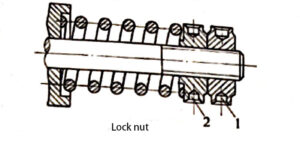 |
During adjustment, loosen the nut 1, screw the nut 2, that is, the support seat, to the required position, and then lock the nut 1 |
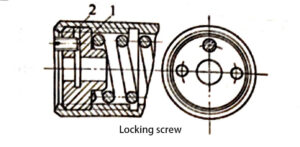 |
During adjustment, loosen the locking screw 2, then adjust the support seat 1, screw it to the appropriate position, and then tighten the locking screw 2 |
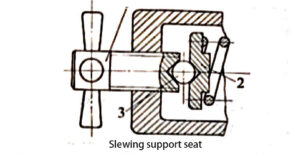 |
Insert a steel ball 3 between the adjusting screw 1 and the bearing seat 2, so that the adjusting screw can rotate freely with the change of spring force |
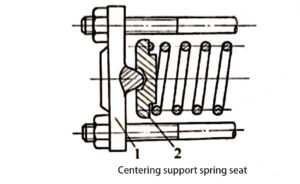 |
Similar to the adjustment structure of the slewing bearing seat, the spring seat 2 can rotate around the centering top 1, which is suitable for large springs |
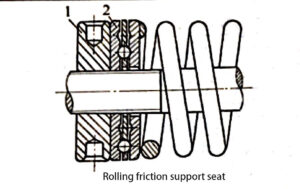 |
The structure of rolling bearing 2 can avoid that the bearing seat 1 drives the spring end coil to twist and makes the spring bear additional torque. It is suitable for large springs that need to adjust the compression force frequently |



